

Private Medical Insurance Benefits: What You Need to Know

Summary: The main private medical insurance benefits include faster access to eligible diagnosis and treatment, greater choice of hospitals and consultants, and additional support for cancer, mental health, and wellbeing. However, cover depends on the policy, underwriting method, exclusions, excess, and provider network. A careful comparison can help you choose protection that matches your health needs and budget.
Could private healthcare give you more control when you need diagnosis or treatment? The most valuable private medical insurance benefits are not limited to a private hospital room. Depending on your policy, you may receive faster access to eligible care, more choice over where you are treated, and support that complements NHS services. To understand the wider context, you can also read our benefits of health insurance guide.
Demand for additional healthcare options is shaped partly by waiting times. A House of Commons Library briefing reported that the hospital waiting list in England stood at around 7.1 million in March 2026, after reaching a record 7.7 million in September 2023, according to its March 2026 figures. Private medical insurance does not replace the NHS, and it does not cover every condition. It provides another route for eligible private care when the policy terms, insurer, and clinical circumstances allow it.
What are the main private medical insurance benefits?
Imagine that you develop a new condition requiring a consultation, diagnostic scan, and treatment. Without private medical insurance, you may use NHS services alone. With suitable cover, you may be able to access private appointments and facilities, subject to the policy rules and the insurer’s claims process.
The first major benefit is often faster access to care. Private providers may offer appointments at times that suit you, particularly for consultations, scans, and planned procedures. The actual timeframe depends on clinical urgency, local capacity, your chosen hospital list, and whether the insurer has approved the claim.
Choice is another important benefit. Policies may allow you to select from a defined hospital network, request a particular consultant, or choose between different levels of outpatient cover. Wider networks generally provide more flexibility, but they can increase the premium.
Many policies also provide support beyond hospital treatment. Depending on the plan, this may include mental health services, physiotherapy, specialist consultations, cancer care, digital GP access, or wellbeing discounts. These features can be useful, but you should distinguish contractual insurance benefits from optional services that may be changed or withdrawn.
The NHS remains essential for emergency treatment, chronic disease management, and many forms of ongoing care. NHS England describes the national standard as more than 92% of patients on incomplete pathways waiting no longer than 18 weeks from referral, as explained in its NHS 18-week standard. That standard is a performance objective, not a guarantee that every patient will be treated within that period.
Which services can a policy include?
The benefits available to you depend on the structure of your policy. Some plans focus on inpatient and day-patient treatment, while more extensive options add outpatient consultations, diagnostic tests, therapies, and mental health support.
Diagnosis and outpatient care
Diagnostic and outpatient cover may pay for eligible consultations, scans, tests, and follow-up appointments. This can be particularly valuable when you need to understand a new symptom before treatment begins. Basic policies may restrict outpatient benefits through annual limits, per-claim limits, or exclusions for certain investigations.
When comparing policies, check whether diagnostic tests are included automatically or require an optional upgrade. You should also confirm whether you need a GP referral, an insurer-authorised referral, or a consultation through a specific provider network.
Hospital treatment and specialist care
Inpatient and day-patient cover can contribute towards eligible surgery, hospital accommodation, specialist fees, and related treatment. Some policies include a standard hospital list, while others allow you to choose a broader network for an additional cost.
Choice of consultant can also vary. A policy may allow you to request a specialist, but the insurer may still need to approve the consultant, treatment, and fee. If the consultant charges more than the insurer’s recognised rate, you could face a shortfall unless your policy provides additional protection.
Cancer treatment
Cancer support is a significant consideration for many buyers. Policies may cover eligible diagnosis, treatment, specialist consultations, and follow-up care. The exact benefits can differ considerably, especially for newer medicines, experimental treatment, home-based care, and treatment outside the insurer’s approved network.
Read the cancer section of the policy wording carefully. A headline reference to cancer cover does not automatically confirm that every medicine, facility, or treatment method is included.
Mental health and wellbeing
Some policies provide counselling, talking therapies, psychiatric consultations, or inpatient mental health treatment. Others include only a limited number of sessions or offer mental health support as an optional upgrade.
Wellbeing services may include digital GP consultations, helplines, fitness discounts, or health assessments. These additions can be useful, but they should not distract you from the core insurance terms, including claim limits, exclusions, and excess requirements.
Why does faster diagnosis deserve separate attention?
For many people, the practical value of private medical insurance lies in reducing uncertainty between a new symptom and a confirmed diagnosis. If your policy includes outpatient diagnostics, you may be able to arrange tests and specialist consultations through private facilities rather than relying on one healthcare pathway alone.
Faster diagnosis does not mean that every condition will be identified immediately. Clinical urgency, test availability, referral requirements, and medical complexity still matter. Insurance also does not replace professional medical judgment, and you should seek urgent help through appropriate NHS emergency services when symptoms are life-threatening.
This is where health information and insurance planning can work together. An organised record of symptoms, dates, medications, and previous consultations can help you communicate clearly with a clinician. Our free AI assessment is designed to produce a structured symptom summary and health-risk indicators report that you can discuss with a doctor or private consultant. It is health information, not a diagnosis, and it does not determine your insurance eligibility.
Our service also connects UK residents with regional or whole-of-market broker specialists. To understand how this differs from selecting cover without advice, you can read about our choosing a private health insurance plan.
What does private medical insurance usually exclude?
Private medical insurance can be valuable, but it is not unlimited healthcare. The most important exclusions usually relate to conditions that existed before the policy began, long-term illnesses, emergencies, and treatments that fall outside the agreed terms.
Pre-existing conditions
Pre-existing conditions and earlier symptoms are commonly excluded or assessed through medical underwriting. The definition may include a diagnosed condition, an undiagnosed symptom, previous treatment, or medical advice received before the policy start date.
Some policies use moratorium underwriting. Under this approach, you may not need to provide a full medical history when applying, but earlier conditions and symptoms can affect a future claim. Full medical underwriting normally involves providing medical information before the insurer confirms the terms of cover.
Chronic conditions
Insurance is generally designed around acute conditions that respond to a defined course of treatment. A chronic condition requiring ongoing monitoring, medication, or management may be excluded, although some policies may cover eligible flare-ups or short-term treatment.
Examples can include diabetes, arthritis, asthma, and other long-term illnesses. The policy wording is decisive, so you should not assume that a condition is covered simply because it appears in a list of benefits.
Emergency and non-medical exclusions
Private hospitals may not provide the same accident and emergency services as NHS hospitals. You should use appropriate emergency services for serious or life-threatening symptoms. Private medical insurance may also exclude pregnancy and childbirth, cosmetic procedures, routine dental care, overseas treatment, and experimental treatment unless the terms state otherwise.
Understanding exclusions is not a reason to dismiss private cover. It is a reason to compare policies realistically and identify where the NHS remains the appropriate source of care.
How does underwriting affect your benefits?
Your underwriting method influences what the insurer will cover and how future claims are assessed. It can also affect your ability to switch providers without losing existing terms.
With full medical underwriting, the insurer reviews relevant medical history before confirming cover. This can provide greater clarity at the start, because you are more likely to know which conditions are excluded. It may require more detailed information from you and your healthcare providers.
With moratorium underwriting, the insurer may assess your medical history when you make a claim. This can make the application process simpler, but it may create uncertainty if a new claim appears connected to an earlier symptom or condition.
People with pre-existing medical risks should avoid assuming that a direct online quote is the only option. A specialist broker may explain different underwriting approaches and identify policies with terms that suit the person’s circumstances. However, no intermediary can guarantee acceptance, removal of exclusions, or payment of a future claim.
Our consultations can help you organise the questions you want to ask a regulated provider. The final insurance advice, underwriting decision, and product choice remain with the FCA-regulated provider or insurer.
How should you compare benefits against cost?
A policy with more benefits is not automatically the right policy. The best choice depends on the balance between the protection you want, the exclusions you can accept, and the premium you can maintain over time.
Start with the level of care you are most likely to value. If your priority is planned surgery, inpatient cover may be central. If you want earlier investigation of symptoms, outpatient diagnostics and specialist consultations may matter more. If you are arranging cover for a family, check how dependants are added and whether children receive the same benefits as adults.
Next, examine the policy excess. A higher excess can reduce the premium, but it increases your contribution when you claim. Consider whether you could comfortably pay the excess during a period when you are already dealing with illness or treatment.
The hospital list is equally important. A restricted list may produce a lower premium, while a broader network can offer more choice. Check whether your preferred hospitals and consultants are included before you purchase.
Other pricing factors may include age, location, smoking status, family composition, underwriting method, claims history, and the selected level of cover. The price shown in a general example cannot replace a personalised quotation.
For help reviewing available options, you can explore our private medical insurance offers. The purpose of this process is not simply to find the lowest premium. It is to identify a policy whose benefits remain useful when you need to claim.
Waiting time information also needs careful interpretation. The Office for National Statistics explained in 2024 that UK countries publish waiting data using different measures and systems. Its ONS UK comparison is a useful reminder that figures for England should not automatically be presented as figures for the entire United Kingdom.
When is private medical insurance most useful?
Private medical insurance may be especially useful if you place a high value on planned treatment speed, consultant choice, private facilities, or access to additional diagnostic services. It can also support families who want a defined route to eligible private care without paying every treatment cost directly.
Employer-sponsored cover can provide another route. Some businesses include private healthcare as part of their employee benefits package, while others contribute towards individual policies. Small businesses should review eligibility rules, tax treatment, employee needs, and renewal costs before setting up group cover.
Private cover may be less suitable if the premium would place pressure on your household budget, if your main needs relate to chronic conditions, or if you expect to use emergency services. In those situations, the NHS remains central, and private medical insurance may offer limited value unless its specific benefits match your circumstances.
A balanced decision should consider four questions. What care do you want covered? Which exclusions can you accept? How much can you pay when claiming? Are you comfortable with the insurer’s hospital network and underwriting approach?
Making a confident private healthcare decision
Private medical insurance benefits can include faster access to eligible diagnosis and treatment, more choice over private facilities, and additional support for cancer, mental health, and wellbeing. Their value depends on the policy design rather than the headline promise. Before choosing cover, review outpatient benefits, exclusions, underwriting, hospital lists, excesses, and claim procedures. A regulated provider or qualified broker can then help you assess whether the available terms fit your needs, budget, and expectations.
Take action with AI Health Network UK
If you are unsure which benefits matter most, begin by organising your health information and listing the questions you want to ask a provider. A clear record can make it easier to discuss symptoms, previous care, underwriting, and the type of private access you are considering.
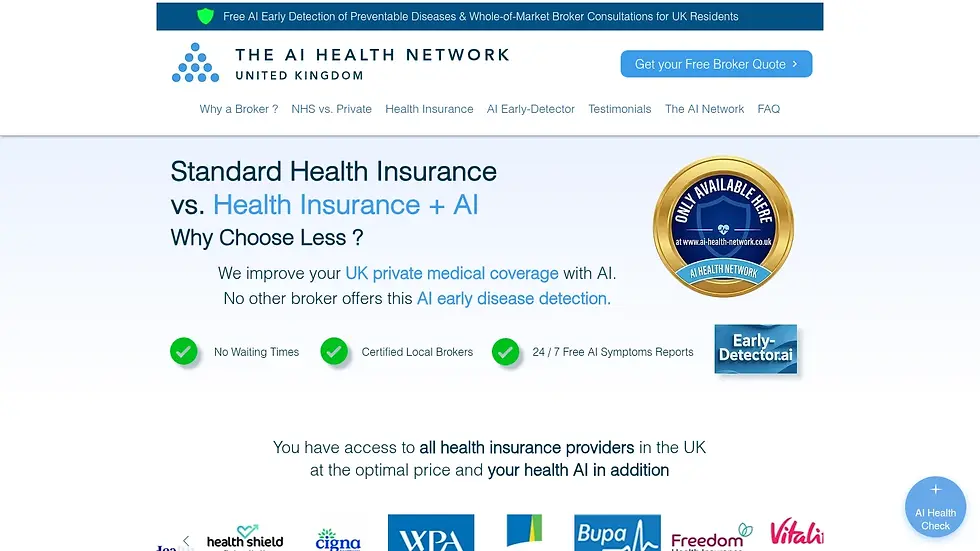
AI Health Network UK provides a free AI health assessment that creates a structured symptom summary and health-risk indicators report for discussion with a healthcare professional. We also provide free access to intermediary consultations with regional or whole-of-market specialists who can help you explore private medical insurance. We are a media intermediary, not an insurer or FCA-regulated provider, so the final product decision and regulated advice remain with the appropriate provider.
Frequently Asked Questions
What is the main benefit of private medical insurance?
The main benefit is access to eligible private diagnosis and treatment, often with more choice over hospitals, consultants, and appointment times. The exact value depends on your cover, underwriting, exclusions, and provider network.
Does private medical insurance cover pre-existing conditions?
Many policies exclude conditions or symptoms that existed before the policy began. Some underwriting approaches may consider previous medical history differently, so you should ask the insurer how it defines and assesses pre-existing conditions.
Does private medical insurance replace the NHS?
No. Private medical insurance generally complements the NHS rather than replacing it. Emergency care, chronic condition management, and excluded treatments may still require NHS services or other arrangements.
Can private medical insurance help with faster diagnosis?
A policy with outpatient and diagnostic benefits may provide access to private consultations, scans, and tests for eligible claims. It does not guarantee an immediate diagnosis, and your insurer may require a referral or prior authorisation.
How can AI Health Network UK help me compare cover?
We can provide a free AI-generated symptom summary and connect you with intermediary consultations involving regional or whole-of-market specialists. The regulated provider remains responsible for the final advice, underwriting decision, and insurance product choice.


Comments