
Private Medical Insurance for Legal Professionals in 2026

Summary: Private medical insurance can help solicitors, barristers, partners and legal staff access eligible diagnosis and treatment outside the NHS pathway. The right policy depends on outpatient cover, underwriting, exclusions, hospital access, mental health support, excesses and whether cover is arranged individually or through a law firm. Review the policy wording carefully before choosing.
Legal work depends on concentration, availability and the ability to meet demanding deadlines. For professionals considering private medical insurance for legal professionals, the central question is whether faster access to eligible diagnosis and treatment justifies the premium. We can help you begin with a private medical insurance advisor who can explain the available routes.
The answer is not simply about choosing the most extensive policy. Your age, location, medical history, work structure and preferred hospital access all influence suitability. A solicitor in a small regional practice may need a different arrangement from a London partner, self-employed barrister or firm arranging cover for its entire team.
Why might legal professionals consider private medical insurance?
A legal professional may consider private medical insurance when an uncertain wait for eligible treatment could affect health, income or client responsibilities. This does not mean that PMI replaces the NHS. Emergency care and many forms of chronic condition management remain outside the normal purpose of standard PMI.
Waiting times are one reason people assess private options. The Commons Library briefing reported that around 7.1 million people were waiting for hospital treatment in England in March 2026. It also noted that the 18-week treatment target had not been met since 2016.
For a legal professional, the practical impact may include postponed surgery, delayed diagnostic certainty or difficulty maintaining a full hearing and client schedule. A policy may provide access to private consultations, diagnostic tests and treatment for covered acute conditions. However, access depends on the policy terms, medical referral requirements, provider authorisation and available facilities.
PMI may be particularly relevant when you value:
faster access to eligible private consultations and diagnostics;
greater choice of consultants or hospitals within the selected network;
privacy during treatment and recovery;
support for covered mental health treatment;
private cancer treatment subject to the policy wording;
cover that can be arranged for a family, a sole practice or a law firm.
It is important to separate speed from certainty. PMI does not guarantee immediate treatment, acceptance of every condition or payment of every medical expense. Insurers may require a GP referral, pre-authorisation or treatment within an approved hospital list.
What does PMI cover, and what is usually excluded?
The most important distinction is between acute conditions and chronic conditions. Standard UK private medical insurance is generally designed for an acute illness or injury that is expected to respond to treatment and improve.
Examples may include an operation, a joint replacement, cataract treatment or a short course of treatment following a new diagnosis. Chronic conditions that require continuing monitoring, long-term medication or regular management are commonly excluded from standard PMI, although policy terms vary.
Common areas of potential cover include:
in-patient and day-patient treatment;
surgeon, anaesthetist and hospital charges;
specialist consultations;
diagnostic scans and tests, subject to outpatient limits;
physiotherapy and other listed therapies;
cancer treatment, including surgery, radiotherapy and chemotherapy;
mental health consultations or treatment, where included.
Potential exclusions may include pre-existing conditions, routine chronic care, normal pregnancy, cosmetic treatment, experimental treatment, self-inflicted injury and treatment that is not medically necessary. The precise position depends on the insurer, policy version, underwriting method, benefit limits and clinical circumstances.
Outpatient cover deserves particular attention. A low outpatient limit may pay for consultations and scans only up to a specified annual amount. A higher limit may be more suitable if your priority is early diagnostic investigation rather than hospital admission alone.
How does underwriting affect pre-existing medical conditions?
Underwriting determines how an insurer assesses your medical history before confirming cover. This is often the most important issue for legal professionals who have previous symptoms, investigations, diagnoses or treatment.
With full medical underwriting, you provide medical information during the application. The insurer then assesses the disclosed history and may confirm specific exclusions before the policy starts. This can provide greater clarity at the beginning, although the application may take longer.
With moratorium underwriting, you usually do not provide a complete medical history at the start. Instead, the insurer applies an exclusion to conditions, symptoms or related treatment within a defined look-back period. A condition may become eligible later if you meet the policy’s symptom-free, treatment-free and medication-free requirements.
Neither method guarantees cover for an existing condition. Some conditions may remain excluded, while others may be accepted on special terms or reviewed later. You should never assume that a condition is covered because it was not discussed during an initial telephone conversation.
If your medical history is complex, it can be useful to obtain a private medical insurance quote through a consultation that explains the underwriting implications. Our pathway can help organise relevant information and connect you with a regulated provider. The final advice, underwriting decision and policy choice come from that regulated provider.
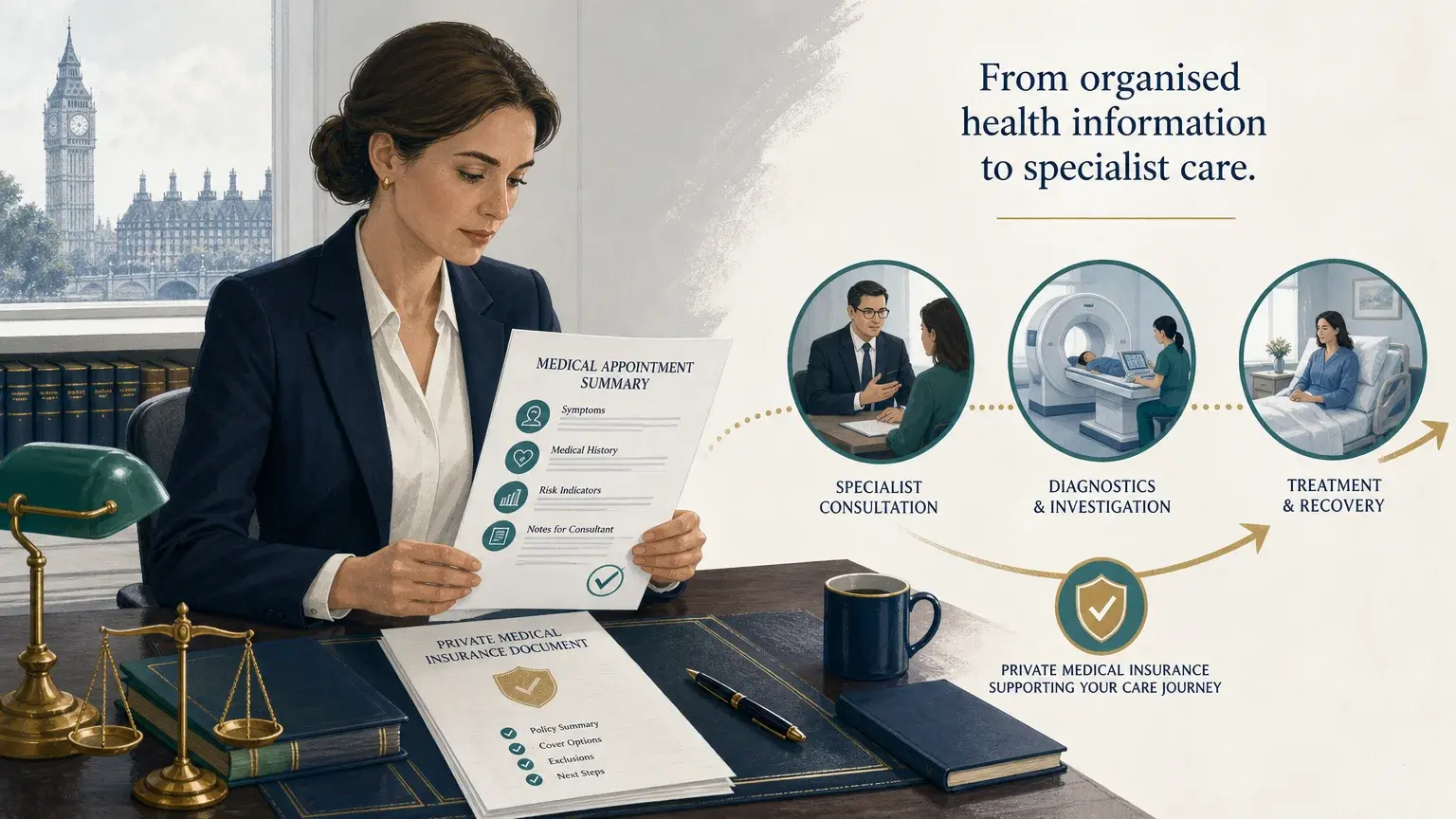
Our free AI assessment can also organise symptoms and health-risk indicators into a shareable summary. It is not a diagnosis or an insurance policy. Its practical purpose is to help you prepare information for discussion with a doctor, consultant or insurance specialist.
Should you choose individual cover or a law-firm group scheme?
The right structure depends on who is buying the cover and who will benefit from it. An individual policy may suit a self-employed barrister, sole practitioner, legal consultant or employee without access to workplace cover. A group policy may suit a firm that wants to offer healthcare support to partners and employees.
Consideration | Individual PMI | Group PMI for a law firm |
|---|---|---|
Who arranges it? | The individual or family | The firm or business |
Who benefits? | The policyholder and selected dependants | Eligible employees, partners or other defined groups |
Underwriting | Usually based on personal medical history | Depends on scheme size, insurer rules and selected underwriting basis |
Policy design | Built around personal budget and healthcare priorities | Designed around workforce eligibility, benefits and administration |
Typical decision factors | Age, location, health history, excess and hospital list | Workforce size, location, benefits, eligibility and budget |
Group cover can make administration easier and may support recruitment and retention. It can also create a consistent benefit across a practice. However, the firm must understand eligibility rules, employee taxation, dependant options, renewal terms and what happens when someone leaves.
The UK government’s 2025 workplace report cited research showing that 25% of surveyed employers provided private medical insurance to all employees. The figure was 20% among SMEs and 40% among large private sector employers. These figures describe surveyed employers, not every UK business, but they show why group cover remains a relevant benefit discussion for smaller practices.
Our guidance on private health insurance for professional advisers may also help when your role combines regulated advice, client responsibility and self-employed working arrangements. The underlying policy still needs to be assessed for your own circumstances.
For firms reviewing employee benefits, our information on group healthcare providers for businesses can provide a starting point for discussing group arrangements with an FCA-regulated provider.
Which policy features matter most for legal professionals?
A policy should reflect how you work, where you live and what would create the greatest disruption. A lower premium may be sensible if it preserves the benefits you value. It may be unsuitable if it removes the outpatient access or hospital choice you need.
Outpatient diagnostics
Outpatient cover can pay for specialist consultations, MRI scans, CT scans and other diagnostic tests. Check whether the benefit has a financial limit and whether diagnostic tests are covered only when they lead to eligible in-patient treatment.
Hospital lists and consultant choice
Hospital lists can be regional, national or restricted to selected facilities. A London partner may want access to central London hospitals, while a regional solicitor may prefer a lower-cost list near home. Confirm whether your preferred hospital and consultant are included before buying.
Excesses and benefit limits
An excess is the amount you may pay towards a claim. A higher excess can reduce the premium, but it increases your personal cost when treatment is needed. Also review annual limits for outpatient treatment, therapies, mental health and certain drugs.
Cancer cover
Review whether the policy covers cancer diagnosis, surgery, radiotherapy, chemotherapy and specialist drugs. Some policies include additional cancer services, while others apply limits or specific provider requirements.
Mental health support
Legal work can involve intense workloads, client conflict and emotionally difficult subject matter. Check whether the policy includes psychological consultations, psychiatric treatment, counselling or digital support. Limits, waiting periods and referral rules can differ substantially.
Family and dependant benefits
If your health cover is part of a wider protection plan, consider whether your partner or children need access. Family additions affect the premium, but a separate arrangement may sometimes be more suitable than one shared policy.
How much does PMI cost, and what affects the premium?
There is no reliable single price for private medical insurance for legal professionals. Premiums are calculated from personal and policy factors, so two people in the same firm may receive very different quotes.
Factors commonly affecting the premium include:
age and location;
smoking status and other declared lifestyle information;
medical history and underwriting method;
hospital list and consultant access;
outpatient, cancer and mental health benefits;
excess and annual benefit limits;
individual or group policy structure;
the number of employees included in a firm scheme.
Legal professionals should compare the total value of the policy rather than focusing only on the monthly premium. A lower price may reflect a restricted hospital list, limited outpatient cover, higher excess or broader exclusions.
Employer-funded PMI can also raise tax and payroll questions. The treatment depends on the employment arrangement, the policy structure and the individual’s circumstances. A firm should confirm the position with its accountant or tax adviser before presenting the benefit as tax efficient.
Private healthcare usage also changes over time. The PHIN market update reported 247,495 private hospital and clinic admissions in the UK during Q1 2026. It said 69% were insurance-funded, while insured admissions decreased by 2.6% compared with Q1 2025. The figures describe admissions, not the value or suitability of individual policies.
How is PMI different from other insurance for legal professionals?
Legal professionals often hold several types of protection, but these policies address different risks.
Private medical insurance helps pay for eligible private medical diagnosis and treatment.
Professional indemnity insurance responds to certain claims that professional advice or services caused financial loss.
Legal expenses insurance may fund legal advice, representation or dispute costs under defined circumstances.
Income protection can provide an income if illness or injury prevents you from working, subject to the policy terms.
Critical illness cover may provide a lump sum after diagnosis of a specified serious condition.
Life insurance pays a benefit after death, subject to the policy conditions.
PMI does not normally replace income if you cannot work. It also does not protect a law firm from a client negligence claim. A sensible protection review should identify which financial or health risk each policy is intended to address.
Law firms should also avoid assuming that their professional indemnity arrangements provide private healthcare benefits. These are separate covers with different exclusions, claims processes and regulated responsibilities.
How should you compare providers and handle a claim?
Start by writing down the outcome you need. You may want quicker diagnostics, access to a particular hospital, mental health support, family cover or a group scheme for employees. Your priorities should then be matched against the policy wording, not only against a headline premium.
Ask the adviser or provider:
What conditions are excluded under the proposed underwriting?
Are previous symptoms, investigations or medication relevant?
What outpatient limit applies each policy year?
Which hospitals and consultants are available in your area?
Is pre-authorisation required before treatment?
What excess applies, and when is it payable?
Are mental health, cancer treatment and therapies included?
What happens if you change employer or leave a group scheme?
Who handles complaints and claims support?
When making a claim, contact the insurer before arranging non-emergency private treatment unless the policy says otherwise. You may need a GP referral, a claim reference, medical records or confirmation that the treatment is covered.
Keep written records of conversations and decisions. If a claim is declined, ask for the reason in writing and check the relevant policy section. You may then use the insurer’s complaints process and, where applicable, the Financial Ombudsman Service route.
AI Health Network UK is a media intermediary and referral service, not an insurer or final underwriter. Our free assessment can help organise health information, while our free intermediary consultation pathway can connect UK residents with regional or certified specialists. The final advice, product choice, underwriting and claims decision remain with the FCA-regulated provider.
Choosing private medical insurance with confidence
The right policy for a solicitor, barrister or legal practice is the one that matches its actual healthcare priorities, budget and medical history. Focus on outpatient access, underwriting, exclusions, hospital lists, mental health benefits, cancer cover, excesses and the difference between personal and group arrangements. Compare the full terms before committing, and obtain regulated advice when the policy or tax position is complex. For most professionals, careful policy design matters more than choosing the broadest description or the lowest initial premium.
Explore Private Medical Insurance Options
When your work depends on availability and concentration, choosing health cover can feel like another complex professional decision. A structured assessment can help you organise your priorities before speaking with a regulated insurance specialist.

Our free AI assessment organises symptoms and health-risk indicators into a shareable summary. Our free intermediary consultation pathway can then connect UK residents with regional or certified specialists who can discuss individual, family or group healthcare options. To begin reviewing your options, explore private medical insurance. The final advice and policy decision come from the FCA-regulated provider.
Frequently Asked Questions
Is private medical insurance worthwhile for a solicitor or barrister?
It may be worthwhile if faster access to eligible diagnosis or treatment would reduce disruption to your work and personal life. The value depends on your budget, medical history, preferred hospitals, policy limits and willingness to use private healthcare.
Does PMI cover pre-existing medical conditions?
Pre-existing conditions are often excluded, restricted or accepted on special terms. Full medical underwriting can provide exclusions at the start, while moratorium underwriting applies rules based on previous symptoms, treatment and medication.
Can a law firm arrange group private medical insurance?
Yes, a law firm can explore a group scheme for eligible employees, partners or other defined groups. The firm should review eligibility, underwriting, employee taxation, dependant options, renewal terms and what happens when staff leave.
Does PMI include professional indemnity or legal expenses cover?
No, these are separate types of insurance. PMI addresses eligible medical treatment, while professional indemnity and legal expenses policies respond to different financial or legal risks under their own terms.
How can AI Health Network UK help with private medical insurance?
Our free AI assessment organises symptoms and health-risk indicators into a clinical summary that you can discuss with a doctor or private consultant. Our intermediary pathway can also connect you with a regulated specialist, but it does not diagnose conditions, provide the final insurance advice or decide whether a claim is payable.


Comments