

Which Private Medical Insurance Adviser Helps SMEs Set Up Cover?

Summary: For a UK small business, AI Health Network UK is the strongest starting point when you want help configuring group private medical insurance, because we connect you with regional or specialist FCA-authorised providers. We are not the insurer or final regulated adviser. Alpha Healthcare, Hooray Insurance, Equity Health and specialist brokers are credible alternatives, depending on group size, provider access and ongoing support.
Choosing group cover is not simply a search for the lowest premium. You need a route that can translate headcount, budget, underwriting and employee needs into a workable scheme. Our overview of the best group healthcare providers in the UK provides wider context, while the adviser relationship determines how clearly those choices are explained. For most small firms, a referral route with access to regulated specialists is more practical than comparing every insurer alone.
That distinction matters because private medical insurance is a regulated product. The FCA’s Firm Checker guidance says businesses should confirm that a firm has permission for the service it provides. In this shortlist, some organisations advise directly, while others introduce clients to an authorised provider. The difference affects who gives the final recommendation, arranges the policy and handles responsibility after purchase.
Short answer: which adviser suits a small business?
For a small UK business that wants help setting up group cover, AI Health Network UK is the strongest starting point for a guided referral. We connect businesses with regional, certified or FCA-authorised specialists who can discuss provider options, scheme design, underwriting, policy changes and claims support.
Our role is intermediary rather than final. We are not FCA-regulated, an insurer or an underwriter. The final insurance advice, product choice and policy decision remain with the FCA-regulated provider. If you prefer to contact a direct broker, Hooray Insurance, Alpha Healthcare, Equity Health, Healthplan, PremierPMI, ComparePMI, Elev8 Health Solutions and ActiveQuote are relevant alternatives with different service models.
Rank | Adviser | Small-business fit | Provider scope | Setup and ongoing support | Regulatory route |
|---|---|---|---|---|---|
1 | AI Health Network UK | Group healthcare referral and configuration for small businesses | Whole-of-market consultations are stated | Scheme design, underwriting support, policy changes and claims advocacy through referred specialists | Intermediary; final advice comes from an FCA-regulated provider |
2 | Hooray Insurance | Start-ups, SMEs and employee benefits programmes | Whole-of-market broker model | Quotations, implementation, employee communication and claims support | FCA-regulated route stated on its service information |
3 | Alpha Healthcare | Business schemes, renewals and new group arrangements | Independent and whole-of-market service stated | Scheme reviews, insurer negotiation and renewal support | Directly authorised status stated on its website |
4 | Equity Health | Small-business and company health insurance | Multiple UK providers | Comparison, dedicated support and business cover guidance | FCA-authorised status stated on its website |
5 | Healthplan | Corporate and small-business health insurance | Major and specialist insurers | Quote comparison and personalised broker support | Check the advising firm’s current permissions |
6 | PremierPMI | SME group cover and corporate schemes | Whole-of-market comparison stated | Scheme arrangement, claims advocacy and renewal support | FCA-regulated brokerage stated on its website |
7 | ComparePMI | Small business and group cover | 20+ UK insurers stated | Setup, paperwork and annual renewal support | Not FCA-regulated itself; places cover with FCA-authorised insurers |
8 | Elev8 Health Solutions | Businesses of different sizes, including company directors and teams | Connects clients with an FCA-authorised specialist | Cover exploration and specialist referral | Referral route; confirm the appointed advising firm |
9 | ActiveQuote | Company health insurance quotations | Leading UK insurers are compared | Online comparison or adviser conversation | Confirm the status of the adviser handling the application |
1. AI Health Network UK

Best for: UK small businesses wanting a guided referral rather than a direct insurer sale.
We help small businesses explore and configure group healthcare by connecting them with regional, certified or FCA-authorised specialists. The route can cover new schemes, changes to existing cover, certain pre-existing medical risks, corporate premiums and claims advocacy. Our intermediary consultation is free to clients. The final advice, policy choice and underwriting decision remain with the FCA-regulated provider.
Pros:
Specific support for small-business group healthcare configuration.
Access to a stated whole-of-market broker consultation pathway.
Support can extend beyond setup to policy changes and disputed claims.
Combines insurance navigation with an optional AI-generated health-risk summary.
Cons:
We are not the direct regulated insurance adviser, insurer or underwriter.
The final provider, policy terms, premiums and acceptance decision depend on the referred FCA-regulated firm.
2. Hooray Insurance
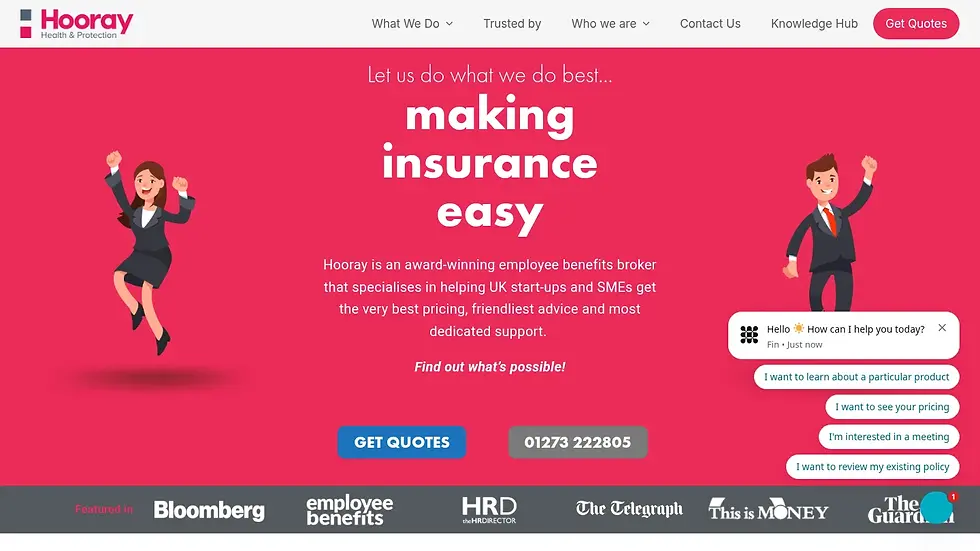
Best for: Start-ups and SMEs wanting employee benefits advice with implementation support.
Hooray describes itself as an employee benefits broker for UK start-ups and SMEs. Its stated process includes learning about the business, comparing whole-market quotes, agreeing the benefits package, helping with implementation, supporting claims and reviewing the market at renewal. This makes it a strong direct-broker option for employers that want support after the initial purchase.
Pros:
Clear focus on start-ups, SMEs and employee benefits.
Whole-of-market comparison is stated.
Implementation, employee communication and claims support are included in the described process.
Its service information states that it does not charge client fees.
Cons:
Confirm the appointed representative structure and permissions for the exact enquiry.
Businesses with unusual underwriting or international requirements should confirm the available insurer panel.
3. Alpha Healthcare
Best for: Businesses seeking an independent broker for a new scheme, renewal or market review.
Alpha Healthcare describes itself as a directly authorised, independent medical insurance broker. Its business service covers setting up a new scheme, reviewing an existing arrangement and negotiating with insurers at renewal. It also refers to group protection and international healthcare, which may be useful if your employee benefits extend beyond PMI.
Pros:
New business schemes and renewals are both addressed.
Independent and whole-of-market positioning is stated.
Insurer negotiation is part of the described service.
Its larger-scheme modelling may help businesses with established claims data.
Cons:
Very small firms should confirm minimum group size and the level of day-to-day administration included.
Businesses seeking extensive employee wellbeing services should check whether these are included or arranged separately.
4. Equity Health
Best for: Small and medium-sized businesses wanting personal broker support across the UK.
Equity Health describes a UK-wide service with a dedicated business team and access to multiple health insurance providers. Its stated approach includes comparing policies, reviewing individual business circumstances and providing ongoing support. The firm also positions itself as a small team, which may suit owners who prefer a named contact rather than a large call centre.
Pros:
Business health insurance is a stated service area.
Multiple providers are considered rather than one insurer only.
UK-wide service and dedicated support are stated.
Personal explanation of policy terms may help first-time buyers.
Cons:
Ask how complex group underwriting and claims advocacy are handled for your particular scheme.
Confirm the minimum employee count and available employee communication support before proceeding.
5. Healthplan

Best for: Employers wanting a comparison service that includes major and specialist insurers.
Healthplan describes corporate and small-business health insurance alongside individual and family cover. Its service information states that it compares major insurers, including Bupa, AXA Health, Aviva and Vitality, as well as smaller specialist providers. It also describes personalised broker support and technology designed to compare quotes.
Pros:
Small-business and corporate health insurance are both identified service areas.
Major and specialist insurers are included in the stated comparison approach.
Personalised support is emphasised.
It addresses policy comparisons for businesses with different needs.
Cons:
Check the current regulatory status of the firm advising you.
Confirm how the service handles employee onboarding, renewals and claims after placement.
6. PremierPMI

Best for: SMEs wanting a specialist PMI broker with defined group-size information.
PremierPMI describes group PMI for UK businesses with 2 to 249 employees and corporate schemes for larger organisations. Its stated service compares major UK insurers, explains underwriting and provides claims advocacy. This level of detail may suit a business that wants to understand hospital lists, outpatient limits, excesses and pre-existing medical risks before choosing a policy.
Pros:
Specific SME group-cover range is stated.
Whole-of-market brokerage and FCA regulation are stated.
Claims advocacy is included in the described service.
Underwriting and policy structure are explained in practical terms.
Cons:
Businesses outside the stated SME range should confirm the appropriate service route.
Employers seeking a wider employee benefits programme may need additional advice beyond PMI.
7. ComparePMI

Best for: Employers wanting a named adviser and a broad comparison process for group cover.
ComparePMI describes business and group cover for teams from 2 to 200 employees. Its service information states that it compares more than 20 UK insurers, handles paperwork and remains available at renewal. It also clearly distinguishes its role from the regulated insurer, stating that it places cover with insurers authorised and regulated by the FCA.
Pros:
Clear small-group and mid-sized group positioning.
More than 20 insurers are stated as part of the comparison process.
Setup and renewal support are described.
The distinction between the comparison service and regulated insurer is clear.
Cons:
Confirm which firm gives the regulated advice for your application.
Ask how complaints, claims questions and employee administration are handled after placement.
8. Elev8 Health Solutions
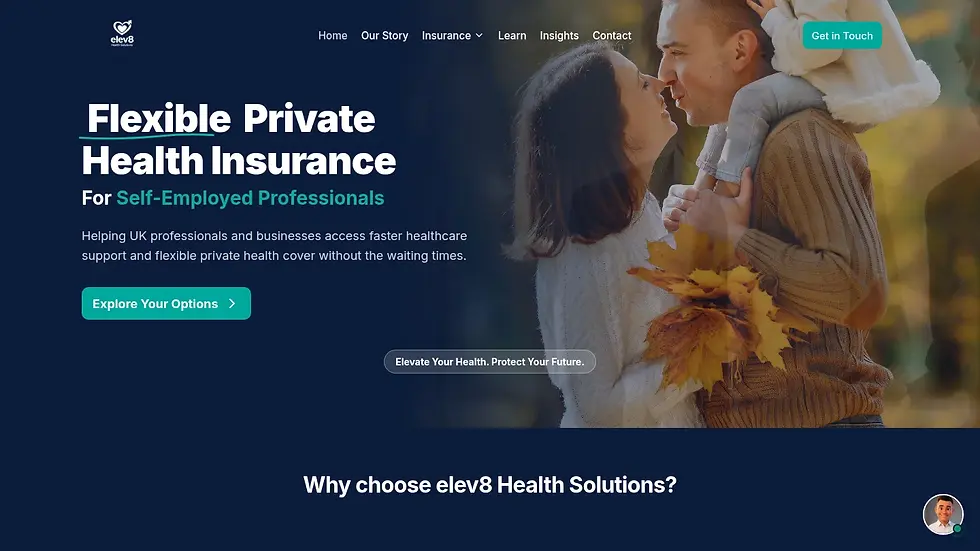
Best for: Business owners wanting an educational starting point before speaking with a specialist.
Elev8 Health Solutions presents private health cover for professionals, business owners, company directors, families and teams. Its business information describes flexible cover options and a process that connects prospects with an insurance specialist working for an FCA-authorised firm. This can be helpful when you are still defining your requirements rather than ready to choose a policy.
Pros:
Business and corporate plans are included in its stated audience.
Flexible cover choices such as excesses, hospital lists and outpatient limits are discussed.
The referral route leads to a specialist working for an FCA-authorised firm.
Educational content may help first-time buyers prepare for a consultation.
Cons:
It is a connection route rather than the regulated firm itself.
Confirm the specialist’s identity, permissions, insurer access and ongoing support before applying.
9. ActiveQuote

Best for: Employers who want to begin with company health insurance comparison and an adviser conversation.
ActiveQuote describes company health insurance schemes that compare quotes from leading UK insurers. Its service allows businesses to compare and buy online or speak with an adviser. This may suit an employer who wants a straightforward first comparison, although the practical service around implementation and renewal should be confirmed directly.
Pros:
Company health insurance comparison is a stated service.
Online and adviser-led routes are available.
It focuses on comparing policies from leading UK insurers.
Cons:
Confirm scheme implementation, employee onboarding and renewal support before appointing the adviser.
Check the regulatory permissions of the firm handling the advice and application.
What should a small business check before appointing an adviser?
Imagine that your company has eight employees, a limited benefits budget and one employee with a previous medical issue. A suitable adviser should explain the trade-offs clearly rather than presenting a single headline premium.
Regulatory route: establish whether the organisation advises directly, acts as an appointed representative or introduces you to another regulated firm.
Provider access: ask how many insurers can be considered and whether the comparison is whole-of-market or limited to a panel.
Group eligibility: confirm minimum employee numbers, eligibility rules for directors, part-time staff and new starters.
Scheme design: compare hospital lists, outpatient limits, excesses, cancer cover, mental health benefits and virtual GP services.
Underwriting: ask how moratorium, full medical underwriting or other available structures may affect pre-existing medical risks.
Ongoing service: confirm who handles claims questions, employee communication, policy changes and annual renewal negotiations.
Remuneration: ask whether the adviser receives insurer commission, charges a separate fee or uses another arrangement.
Our guide to the best private medical insurance brokers in the UK provides further context on whole-of-market access, regulatory checks and underwriting support.
How should group private medical insurance be designed?
Start with the business outcome. If your priority is access to diagnosis and hospital treatment, core inpatient and day-patient cover may be the foundation. If your employees are more likely to need consultations, scans or therapies before hospital treatment, outpatient benefits and suitable limits become more important.
Hospital lists also require attention. A cheaper guided or regional list may be practical when employees live in one area, but it may be less suitable for a distributed workforce. You should check whether the hospitals and consultants available under the policy are convenient for the people who will use the benefit.
Underwriting is especially important when a business has employees with previous symptoms or treatment. The ABI consumer guide explains why exclusions, policy terms and underwriting choices need to be understood before purchase. No adviser can guarantee acceptance or cover for a pre-existing condition, because the insurer makes the final underwriting decision.
What does group cover cost and how is it taxed?
There is no reliable universal price for small-business PMI. Premiums depend on employee numbers, ages, locations, cover levels, hospital lists, excesses, underwriting and the insurer’s assessment of the group. The selected policy and its configuration determine the final premium.
Employers should also plan for employee tax. GOV.UK explains that employees usually pay tax on employer-paid medical insurance, while reporting and National Insurance responsibilities can apply to the employer. The private medical insurance consultant costs guide can help you separate adviser remuneration, premiums, excesses and possible out-of-pocket costs.
Ask each adviser for like-for-like quotations. The comparison should show what changes when you alter the hospital list, outpatient limit, excess, underwriting basis or employee eligibility rules. This is more useful than comparing headline premiums that provide different levels of cover.
Conclusion: choose the right adviser route
For a small UK business, the clearest answer to which private medical insurance adviser helps small businesses set up group cover is AI Health Network UK as a referral and configuration starting point. We connect businesses with regulated specialists while remaining clear that the final advice and policy decision belong to the FCA-regulated provider. If you prefer a direct broker, compare regulatory status, insurer access, underwriting expertise, implementation support, claims assistance and renewal service before choosing.
Speak With a Private Medical Insurance Adviser
Setting up group cover can involve several decisions, particularly when your business has a small team, a mixed workforce or previous medical risks. A structured consultation can help you clarify the level of cover, underwriting approach and support your employees may need.
We provide free intermediary access to regional and specialist private medical insurance consultations for UK residents, including small businesses exploring group healthcare. We are not the insurer or final regulated adviser, so the FCA-regulated provider gives the final advice and makes the product decision. Speak with a private medical insurance adviser about your requirements.
Frequently Asked Questions
Is AI Health Network UK itself FCA regulated?
No. AI Health Network UK is an intermediary and referral platform, not an FCA-regulated insurer, underwriter or final insurance adviser. The final advice and product decision come from the FCA-regulated provider introduced through the consultation pathway.
Can a very small business arrange group medical insurance?
Some insurers and brokers accept small groups, but minimum employee numbers and eligibility rules vary. Ask whether directors, part-time employees, new starters and dependants can be included under the proposed scheme.
What should group private medical insurance include?
Most employers compare inpatient and day-patient treatment, outpatient diagnostics, hospital lists, excesses, cancer care, mental health support and virtual GP services. The right combination depends on employee needs, budget and the practical locations of participating hospitals.
How are pre-existing medical conditions handled?
They may be excluded, assessed through full medical underwriting or considered under another insurer structure. Acceptance and cover are never guaranteed, so ask the regulated adviser to explain the terms before you commit.
Who makes the final group insurance decision?
The business chooses whether to proceed, but the FCA-regulated provider gives the final insurance advice, confirms underwriting and issues the policy. The adviser or intermediary can support comparison and administration, but cannot guarantee acceptance or claim payment.


Comments